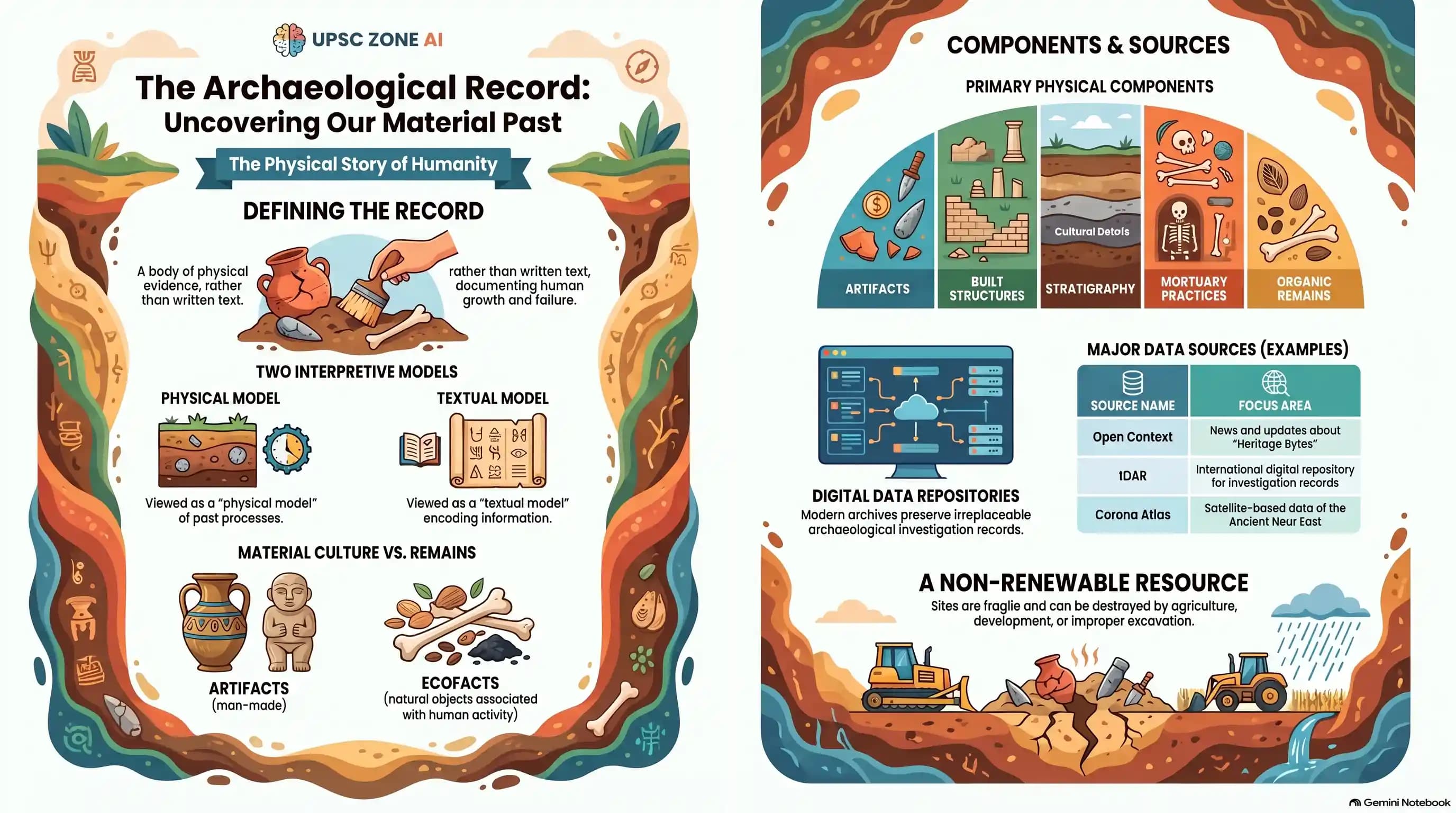
Why is the archaeological record considered a finite resource?
The archaeological record is considered a finite resource primarily because it is composed of physical remains that, once destroyed or altered, cannot be replaced or recreated. This characterisation stems from several key factors identified in the sources:
1. The Destructive Nature of Excavation
Archaeology is often described as a "destructive science". To study a site, archaeologists must physically remove layers of earth and objects from their original context. This process permanently alters the site, meaning that the only surviving record of the original physical evidence is the documentation—such as photographs, site plans, and notes—made by the archaeologists during the process. Because the act of investigation itself consumes the resource, archaeologists often limit the amount of excavation at any single site to preserve parts of it for future study with better technologies.
Live Test Series
Join thousands of aspirants in our weekly live mock tests. Get real-time ranking and detailed analysis.
2. Destruction by Human Activity
The archaeological record is constantly under threat from modern human processes that can damage or entirely destroy potential sites before they can be studied. These include:
Agriculture: Deep ploughing and land clearing can disturb or destroy stratified remains.
Land Development: Construction and infrastructure projects often remove or cover archaeological layers permanently.
Scavenging and Vandalism: The removal of artifacts by non-professionals leads to the loss of both the objects and, crucially, their scientific context.
Live NCERT Foundation
Master the basics with our live NCERT classes. The perfect foundation for your UPSC journey.
3. Natural Decay and Preservation Bias
Not all traces of the past survive long enough to become part of the archaeological record. There is a significant preservation bias, where organic materials (such as wood, textiles, or food remains) often decay quickly unless preserved in rare, special conditions like being waterlogged, charred, or frozen. Consequently, archaeologists are working with only a fraction of the original material culture, making the surviving evidence even more precious and irreplaceable.
4. Unique and Irreplaceable Evidence
Unlike written history, which can be copied and transmitted through the centuries, the archaeological record consists of the original "traces" or "residues" of human activity. If a unique structure, such as an ancient burial or a residential floor, is destroyed by natural phenomena or human interference, the specific data it held about human prehistory and culture is lost forever.
In summary, because the physical evidence of the past is limited in quantity, subject to constant decay, and destroyed by the very methods used to study it, it must be managed as a non-renewable and finite resource.
What is preservation bias?
Aug 14, 2026

Explain UPI Charges on payments?
Aug 13, 2026
Explain the Merchant Discount Rate controversy for prepaid wallet payments.
Aug 13, 2026

How does Chilika Lake's unique ecology support local livelihoods and wildlife?
Aug 4, 2026

Explain the significance of the 2026 Supreme Court sex work judgment.
Aug 3, 2026