
Explain the significance of the 2026 Supreme Court sex work judgment.
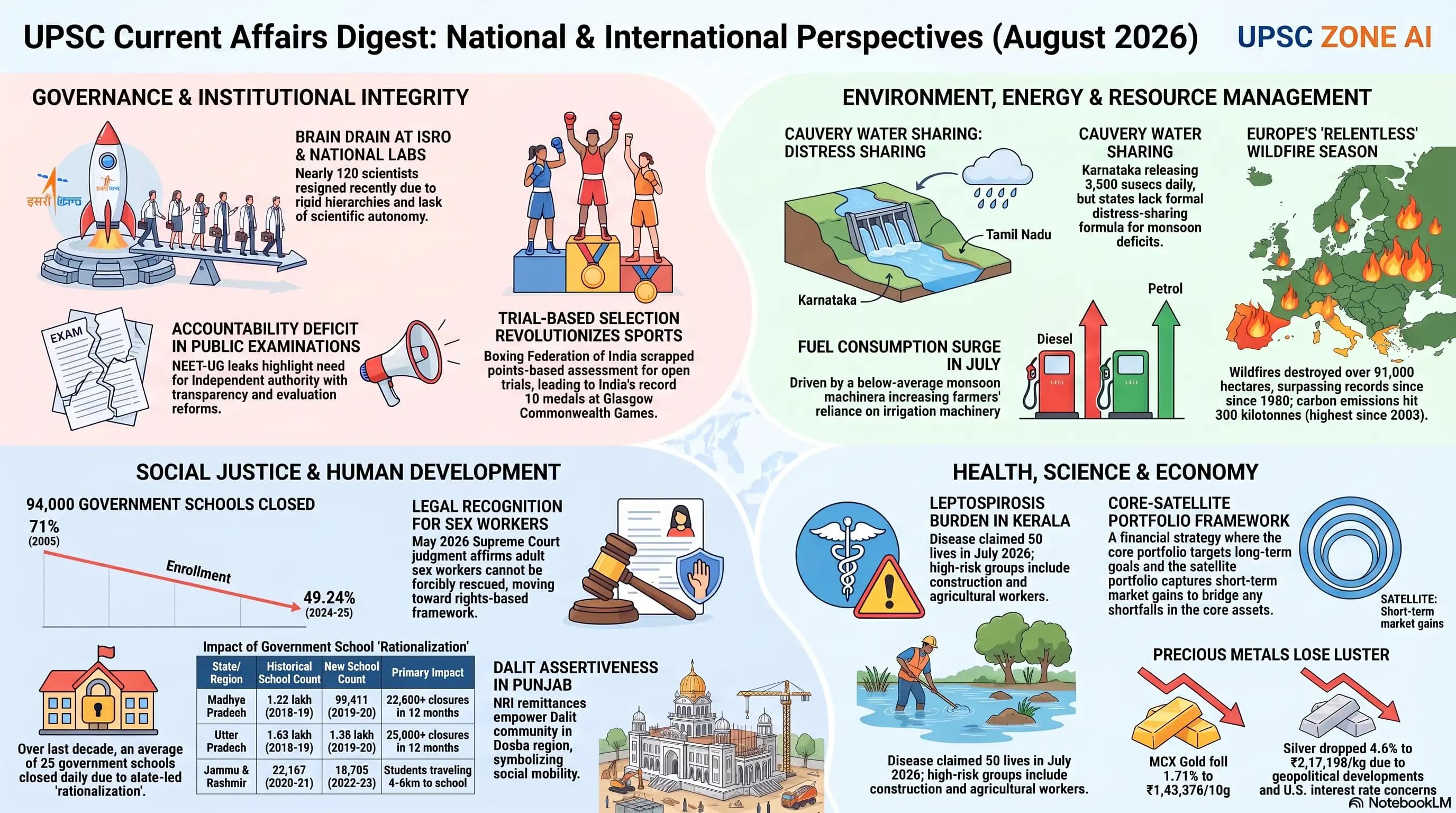
The Supreme Court's judgment on sex work, delivered on May 29, 2026, represents a landmark shift in India’s legal approach to the profession by moving away from traditional anti-trafficking discourse toward a comprehensive rights-based framework.
The significance of this judgment can be broken down into its legal breakthroughs, its inherent paradoxes, and the challenges it identifies for the future:
Live Test Series
Join thousands of aspirants in our weekly live mock tests. Get real-time ranking and detailed analysis.
Key Legal Breakthroughs
Recognition of Agency: The court departs from long-held assumptions by recognizing that agency and vulnerability can coexist. It explicitly rejects the common conflation of migration with trafficking.
Protection from Forced Rescue: A pivotal aspect of the ruling is the affirmation that consenting adult sex workers cannot be forcibly rescued. The court held that any state intervention must begin with a formal inquiry into the individual's consent.
Constitutional Standing: The judgment affirms that constitutional rights are not forfeited due to social disapproval of sex work. To ensure these protections are immediate, the court invoked Article 142 to give its directions full legal force.
The "Paradox" of Knowledge
Despite its progressiveness, the sources highlight a significant contradiction: while the court adopted arguments developed by sex workers and their collectives (such as the National Network of Sex Workers), it failed to officially acknowledge them as the authors of these ideas. This is described as reproducing a "hierarchy of knowledge" where those most affected by the law remain its least recognized contributors.
Live NCERT Foundation
Master the basics with our live NCERT classes. The perfect foundation for your UPSC journey.
Critical Gaps and Implementation Challenges
Institutional Faith vs. Reality: The judgment assumes that clearer legal standards will automatically improve the behavior of police, magistrates, and shelter homes. However, the sources argue that these systems are not neutral and continue to be structured by caste discrimination and economic marginalisation.
The "Rescue Industry": The court is noted to be "noticeably quieter" regarding the violence inherent in the anti-trafficking industry. Critics argue that for many women, indefinite detention in a "corrective" shelter home is simply another form of bondage that can be worse than a standard prison sentence.
Caste as a Barrier: While the court recognizes caste as a structural factor that can push women into sex work, it fails to address how caste prejudices might hinder the actual implementation of these new rights by state officials.
Priorities for Meaningful Change
For this judgment to lead to actual reform, the sources suggest three main priorities:
Advanced GS Course
Deep dive into General Studies with our comprehensive expert-led modules.
Centering Sex Workers: Moving sex workers and their unions from the margins to the center of implementation, allowing them to draft guidelines, shape police training, and establish shelter standards.
NGO Accountability: Subjecting the anti-trafficking NGO sector to greater scrutiny, particularly those involved in coercive rescue practices.
Welfare Access: Ensuring sex workers can access India’s existing welfare architecture as rights-bearing citizens.
Ultimately, the judgment is seen as opening a "constitutional door," but its success depends on whether Indian institutions can move past decades of paternalism and treat sex workers with equal legal respect.
Ethics and Infrastructure (GS Paper IV)
Aug 3, 2026
Does Section 50 search protection apply to bags carried by persons?
Aug 2, 2026
What is the meaning of IMF Rating C?
Aug 1, 2026

How do double deflation and supply use tables improve data?
Aug 1, 2026

Does EWS reservation include people from SC and ST groups?
Jul 29, 2026