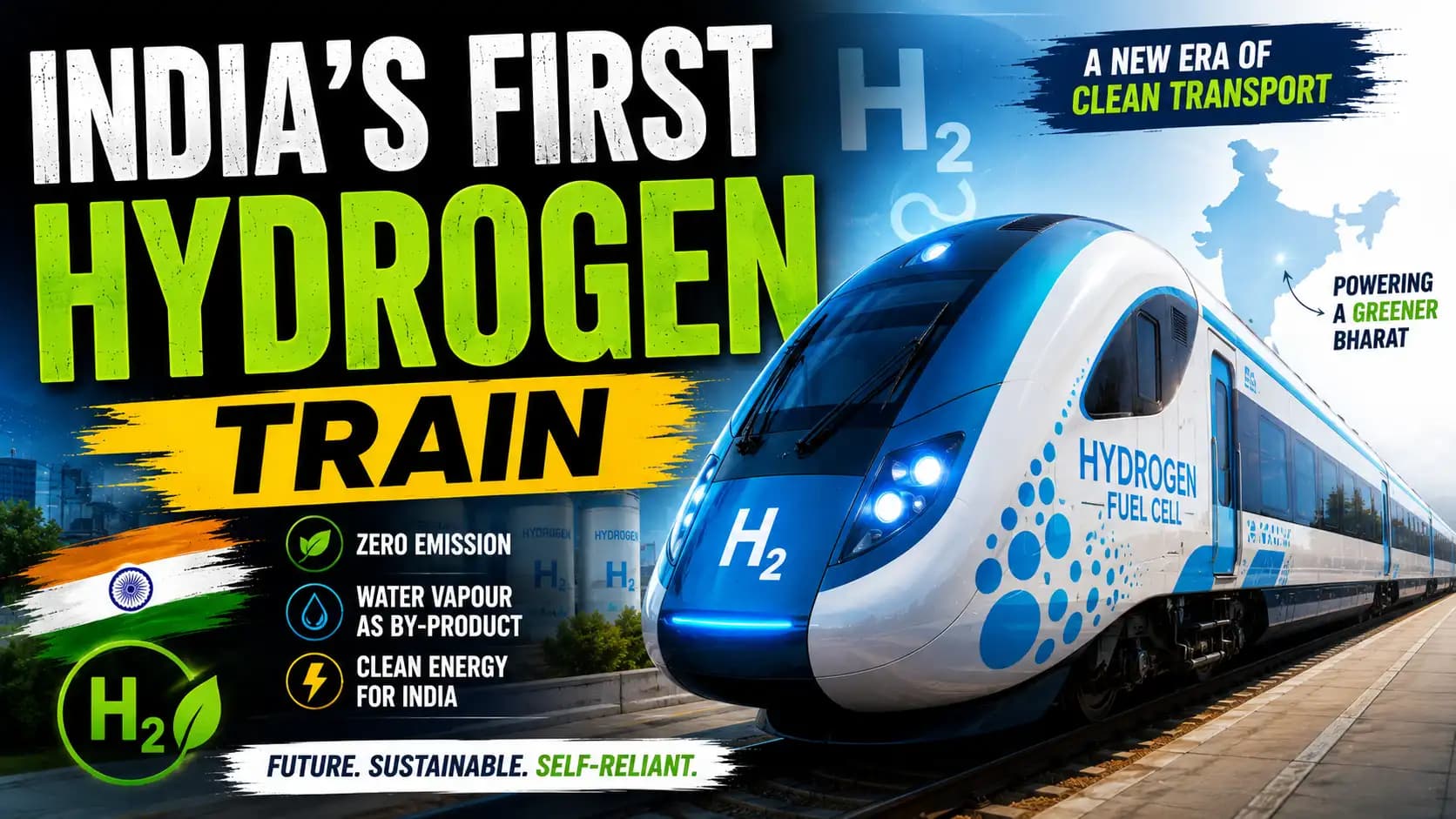
Hydrogen-Powered Rail Mobility in India
Hydrogen-Powered Rail Mobility in India
This study guide provides an in-depth review of India's transition toward hydrogen-powered rail, focusing on the technical specifications, the "Made-in-India" initiative, economic feasibility studies, and safety frameworks.
Glossary of Key Terms
Term Live Test SeriesJoin thousands of aspirants in our weekly live mock tests. Get real-time ranking and detailed analysis. | Definition |
Atmanirbhar Bharat | A government vision for a self-reliant India, emphasized in the design and development of the hydrogen train. |
Bipolar Plates Live NCERT FoundationMaster the basics with our live NCERT classes. The perfect foundation for your UPSC journey. | Components within a fuel cell stack that help distribute gases and collect electrical current. |
Green Hydrogen | Hydrogen produced via electrolysis using renewable energy sources, resulting in zero carbon emissions during production. |
Hydrogen Fuel Cell Advanced GS CourseDeep dive into General Studies with our comprehensive expert-led modules. | A device that generates electricity through a chemical reaction between hydrogen and oxygen, emitting only water vapor and heat. |
Integral Coach Factory (ICF) | The Chennai-based facility responsible for building the railcars and coaches for the hydrogen trainset. |
Membrane Electrode Assembly (MEA) | The core component of a fuel cell where the electrochemical reaction occurs; a technology India currently does not manufacture. |
PEMFC | Proton Exchange Membrane Fuel Cell; a type of fuel cell that uses a solid polymer electrolyte to conduct protons. |
PESO | Petroleum and Explosives Safety Organisation; the body that granted the license for hydrogen storage and dispensing at the Jind facility. |
PGM (Platinum Group Metals) | Rare metals used as catalysts in fuel cells to drive the chemical reaction. |
RDSO | Research, Design and Standards Organisation; the body responsible for framing technical specifications and design approvals for the train. |
SFC (Specific Fuel Consumption) | The amount of fuel consumed per unit of work done, used to measure the fuel economy of locomotives. |
Shunting Yard | A railway yard used for sorting and moving heavy loads over short distances, identified as a prime candidate for hydrogen conversion. |
Frequently Asked Questions (FAQs)
1. Where is India’s first commercial hydrogen train pilot being conducted? The pilot will operate on the Jind-Sonipat section of the Northern Railway in Haryana.
2. What are the primary technical specifications of the Jind-Sonipat trainset? It is a 10-coach trainset powered by a 1200 kW hydrogen fuel cell propulsion system. It has a design speed of 110 km/h but is approved to operate at a maximum speed of 75 km/h for the pilot.
3. Which components of the hydrogen train are genuinely manufactured in India? India handles the systems-integration layer. This includes the construction of the railcar and coaches at ICF Chennai, the retrofitting of diesel-electric multiple-units, and the design of the control systems and traction wiring by firms like Medha Servo Drives.
4. What critical components of the hydrogen train are currently imported? The "energy-conversion core" is imported. This includes the fuel cell stacks (often from Ballard Power Systems in Canada), the perfluorosulfonic-acid membranes (Nafion family), catalysts (Platinum Group Metals), gas diffusion layers (carbon-fibre paper), and carbon-fibre-overwrapped storage tanks.
5. How does the energy density of hydrogen compare to diesel? Hydrogen is a high-energy fuel with an energy density of 120 MJ/kg, which is significantly higher than diesel’s 43 MJ/kg.
6. What is the "Hydrogen for Heritage" initiative? It is a plan by Indian Railways to launch 35 hydrogen trains on various heritage and hilly routes where traditional electrification is technically difficult or cost-prohibitive.
7. Why is the Jind facility significant to this project? Jind houses the country's largest railway hydrogen storage and refueling facility, capable of storing nearly 3,000 kg of hydrogen. It also features a dedicated green hydrogen plant to supply the fuel.
8. What happened to the hydrogen rail projects in Germany that serves as a cautionary tale for India? Germany’s Coradia iLint fleet experienced significant reliability issues. By August 2025, only four of 14 units were running due to fuel cell degradation, hydrogen supply instability, and software issues, leading the state to pivot toward battery-electric trains.
9. What are the specific safety features of India’s hydrogen train? The train includes hydrogen leak detectors, flame detectors, non-stop ventilation systems, and automatic supply cut-offs. The system was certified by an independent third party, TÜV SÜD, Germany.
10. How does the lifetime cost of a hydrogen train compare to a diesel train on the Kalka-Shimla route? According to CSTEP, while a hydrogen train has a higher capital cost (INR 41–50 crore vs. INR 27 crore for diesel), it offers a lower lifetime cost (INR 70–85 crore vs. INR 103.2 crore for diesel) over 30 years.
11. Why are battery-powered trains considered unviable for the heritage and shunting routes? While economically competitive, battery-powered trains currently exceed the weight and volume allowances for these specific locomotives. For example, on the Kalka-Shimla route, the battery alone would weigh 16 tonnes, far exceeding the 9.25-tonne limit for retrofitting.
12. Is the hydrogen used in the Jind-Sonipat pilot truly "green"? While the facility uses an electrolyser to split water, the sustainability depends on the electricity source. If drawn from a coal-heavy grid without a confirmed renewable energy mix, the "green" status is debatable.
13. What firms have signed MOUs to advance hydrogen technology in India? Adani has signed an MOU with Ballard for PEM manufacturing; Hyundai is building an HTWO research centre at IIT Madras; and BHEL has a tie-up with Horizon Fuel Cell Group for fuel cell locomotives.
14. What are the main challenges to scaling hydrogen rail in India? The primary challenges include an unstable global supply chain, high initial capital costs, lack of domestic manufacturing for fuel cell materials (membranes and catalysts), and the nascent stage of green hydrogen production.
15. What is the total estimated cost for the wider rollout of hydrogen trains? The plan aims to put 35 trains into service at a cost of approximately Rs 2,800 crore, with per-train costs pegged at around Rs 80 crore and infrastructure at Rs 70 crore per route.
Practice Quiz
Section 1: Multiple Choice
Which organization prepared the technical specifications and design approval for the hydrogen train? A) ICF B) RDSO C) CSTEP D) Medha Servo Drives
At what pressure is the hydrogen stored in the cylinders for the Kalka-Shimla route model? A) 150 bar B) 350 bar C) 500 bar D) 700 bar
What is the estimated lifetime of a locomotive considered in the CSTEP study? A) 15 years B) 20 years C) 25 years D) 30 years
The first hydrogen-powered smart tram was built by CRRC and is operational in which country? A) Germany B) Japan C) China D) United States
Which Indian city is home to the maintenance facility prepared for hydrogen train operations? A) Chennai B) Hyderabad C) Delhi (Shakurbasti) D) Jind
Section 2: True or False
True or False: India currently mines the Platinum Group Metals (PGMs) required for fuel cell catalysts at a commercial scale.
True or False: The hydrogen train produces water vapor and heat as its only exhaust.
True or False: Electrifying low-frequency routes like industrial shunting yards is more cost-effective than using hydrogen.
True or False: Medha Servo Drives is a Hyderabad-based firm responsible for system integration on the hydrogen train.
Section 3: Short Answer
What is the capacity of the hydrogen storage facility at Jind?
Why did CSTEP rule out battery-powered trains for the Kalka-Shimla route despite their lower fuel costs?
Who is the French manufacturer of the Coradia iLint, the world's first hydrogen passenger train?
What is the energy efficiency of the fuel cells used in the CSTEP study model?
Which specific polymer membrane is identified as the "genuine core" of a fuel stack?
Name one of the three countries (other than India) that are members of the "hydrogen-rail club" mentioned in the source context.
Answer Key
B) RDSO
B) 350 bar
D) 30 years
C) China
C) Delhi (Shakurbasti)
False. India does not mine PGMs at scale.
True.
False. Electrification of these routes has extremely high initial costs (INR 150–183 crore), making it unviable compared to hydrogen.
True.
Nearly 3,000 kg.
Technical weight limitations. The batteries required would exceed the locomotive's weight allowance.
Alstom.
60%.
Perfluorosulfonic-acid film (Nafion family).
Germany, Japan, China, or the United States.
Techno-Economic Comparison (CSTEP Study)
The following table summarizes the lifetime costs and annual emissions for the two primary use cases studied.
Route | Locomotive Type | Capital Cost (INR Cr) | Lifetime Cost (INR Cr) | Annual CO2 (Tonnes) |
Kalka-Shimla | Diesel (Base) | 27 | 103 | 899 |
Green Hydrogen | 41–50 | 70–85 | 6.5 | |
Electrified Line | 150 | 165 | 719 | |
Industrial Yard | Diesel (Base) | 10 | 109 | 1123 |
Green Hydrogen | 15–25 | 83–109 | 1046 | |
Electrified Line | 183 | 221 | 1785 |
Hydrogen-Powered Rail Mobility in India
Jul 17, 2026
How does India's hydrogen train technology compare to global counterparts?
Jul 17, 2026
How does E20 affect mileage for older vehicles?
Jul 15, 2026
What is E20 and how will it reduce oil prices?
Jul 15, 2026

Human Rights, Information Access, and Institutional Frameworks: An Analysis of Article 19 and Related Legal Principles
Jul 14, 2026