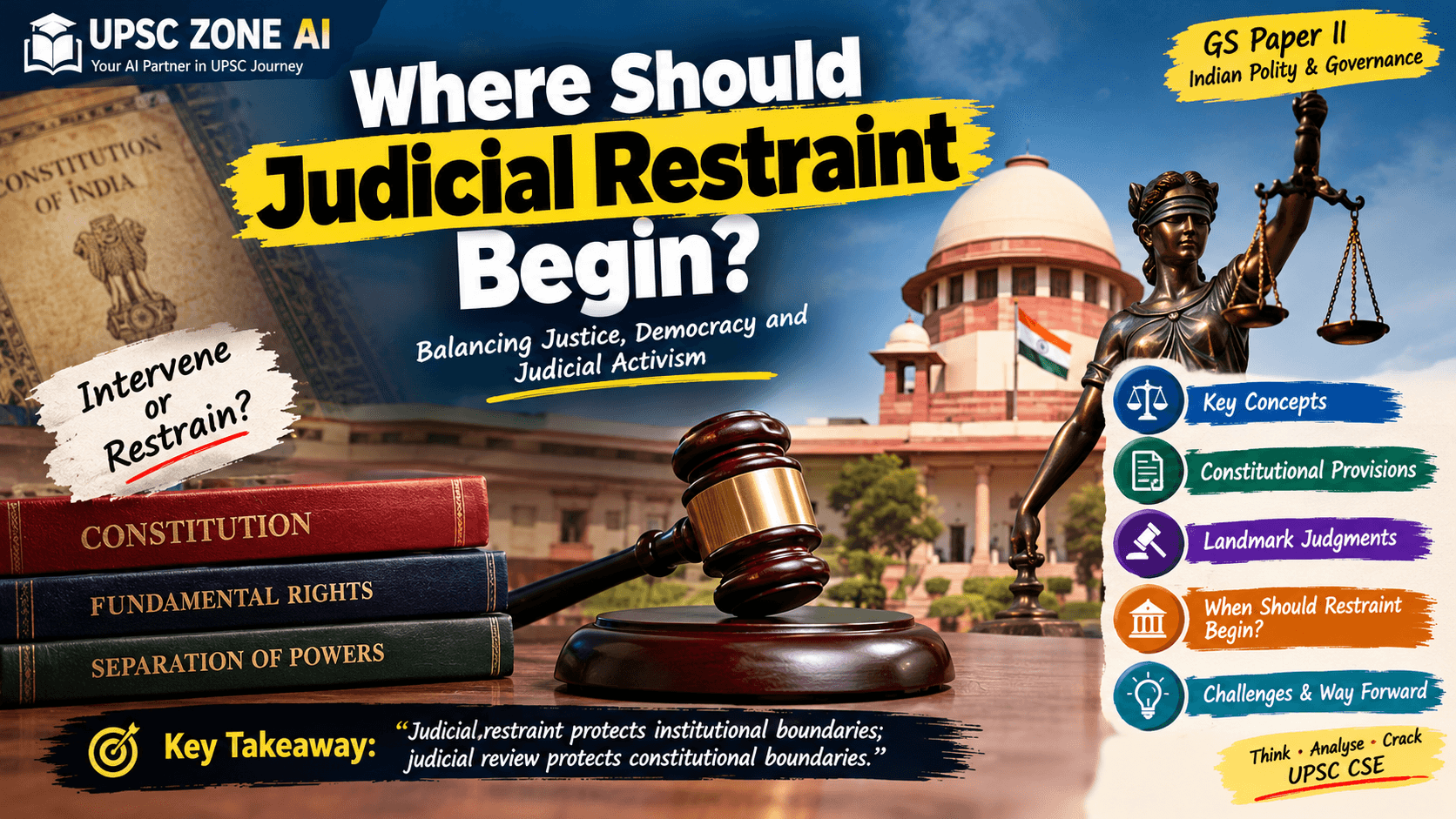
WHERE SHOULD JUDICIAL RESTRAINT BEGIN?
1. What is judicial restraint?
Judicial restraint is a judicial philosophy under which courts exercise their constitutional powers carefully and avoid unnecessarily interfering in decisions that fall within the legitimate domain of the legislature and executive.
It does not mean that courts should remain silent when constitutional rights are violated.
Live Test Series
Join thousands of aspirants in our weekly live mock tests. Get real-time ranking and detailed analysis.
Judicial restraint: Courts respect institutional boundaries and avoid substituting their preferences for those of elected governments.
Judicial activism: Courts take a proactive role in protecting rights, enforcing constitutional obligations, or addressing governance failures.
Judicial review: The constitutional power of courts to examine the legality and constitutionality of laws and executive actions.
Example: A court may invalidate a government policy that violates fundamental rights, but it should generally avoid designing every administrative detail of that policy when the Constitution does not require it to do so.
Live NCERT Foundation
Master the basics with our live NCERT classes. The perfect foundation for your UPSC journey.
2. Why is this debate important?
India follows a parliamentary democracy based on the Constitution, separation of powers, and judicial review. However, the boundaries between these institutions can become contested.
The debate becomes especially important when courts deal with:
Economic policies, subsidies, and resource allocation.
Environmental protection and infrastructure projects.
Advanced GS Course
Deep dive into General Studies with our comprehensive expert-led modules.
Government appointments and administrative decisions.
Electoral processes and democratic rights.
Fundamental rights, preventive detention, and personal liberty.
Delays in legislation or executive action on constitutional obligations.
The challenge is to prevent both judicial overreach and executive or legislative arbitrariness.
3. Constitutional provisions you must remember
The Constitution does not explicitly use the phrase “judicial restraint” as a standalone doctrine. Instead, the debate arises from the constitutional distribution of powers and the limits on each institution.
Article | Significance for UPSC |
|---|---|
Article 13 | Laws inconsistent with Fundamental Rights are void to the extent of inconsistency. |
Article 32 | Right to approach the Supreme Court for enforcement of Fundamental Rights. |
Article 226 | High Courts can issue writs for Fundamental Rights and other legal purposes. |
Article 136 | Supreme Court's discretionary Special Leave Petition jurisdiction. |
Article 141 | Law declared by the Supreme Court is binding on all courts in India. |
Article 142 | Supreme Court may pass orders necessary to do complete justice in a matter before it. |
Article 50 | Directive Principle calling for separation of the judiciary from the executive in the public services of the State. |
These provisions establish both the judiciary's power and its constitutional responsibilities. Articles 32 and 226 are particularly important because restraint cannot become a justification for abandoning the protection of rights.
India
+2
4. Landmark Supreme Court judgments

1. Kesavananda Bharati v. State of Kerala (1973)
The Supreme Court established the Basic Structure Doctrine. Parliament can amend the Constitution under Article 368, but cannot destroy its basic structure.

2. Minerva Mills v. Union of India (1980)
The Court reaffirmed that limited amending power and judicial review are essential to the Constitution. It also emphasised harmony between Fundamental Rights and Directive Principles.

3. S. R. Bommai v. Union of India (1994)
The judgment strengthened judicial review of the imposition of President's Rule under Article 356 and reinforced federalism.
UPSC relevance: Judicial oversight can protect democracy and federal balance against arbitrary executive action.

4. Supreme Court Advocates-on-Record Association v. Union of India (NJAC case, 2015)
The Supreme Court struck down the 99th Constitutional Amendment and the NJAC law, holding them unconstitutional for violating judicial independence, a feature of the basic structure.
UPSC relevance: Judicial independence, judicial appointments, accountability, and separation of powers.
5. Where should judicial restraint begin?
The starting point should be respect for constitutional boundaries, not automatic deference to the government.
A. Economic and fiscal policy
Courts should generally avoid substituting their own economic preferences for those of elected governments on matters such as taxation, subsidies, and resource allocation.
However, intervention may be justified where a policy violates Fundamental Rights, exceeds statutory authority, or is manifestly arbitrary under applicable constitutional standards.
B. Welfare schemes and public administration
Judges should be cautious about designing the operational details of welfare programmes or managing routine administration. Such decisions require technical expertise, budgetary assessment, and democratic accountability.
But when authorities fail to discharge legal duties or deny constitutionally protected entitlements, judicial intervention can be necessary.
C. Fundamental Rights and personal liberty
Restraint must not become passivity. Courts have a vital role in safeguarding liberty, equality, due process, and constitutional remedies.
For example, unlawful detention or discriminatory state action requires meaningful judicial scrutiny.
D. Separation of powers
The legislature makes laws, the executive implements them, and the judiciary interprets the law and reviews constitutionality. These functions overlap in some areas, but no institution should routinely take over the legitimate responsibilities of another.
E. Judicial appointments and institutional accountability
Judicial independence must be protected, while transparency, reasoned decisions, and public confidence remain important. The challenge is to preserve independence without allowing any institution to become immune from legitimate scrutiny.
6. Why is excessive judicial intervention a concern?
Judicial intervention can protect constitutional values, but excessive intervention may create several problems.
Democratic deficit: Judges are not directly elected to formulate public policy.
Institutional overreach: Courts may enter areas requiring legislative deliberation or executive expertise.
Implementation difficulties: Detailed judicial directions may be difficult to implement without administrative capacity or financial resources.
Accountability concerns: Governments are politically accountable for policy outcomes, whereas judicial accountability operates through different constitutional mechanisms.
Unintended consequences: Court-directed policies may create financial or administrative burdens that were not fully considered.
These concerns support judicial restraint, but they do not justify weakening judicial review or allowing unconstitutional conduct to go unchecked.
7. Why is judicial restraint sometimes criticised?
Excessive restraint can also undermine constitutional governance.
Failure to protect rights: Reluctance to intervene can leave citizens vulnerable to arbitrary state action.
Executive dominance: Courts may fail to check the misuse of executive power.
Delayed justice: Procedural or institutional hesitation may prolong violations of individual rights.
Constitutional accountability: An overly deferential judiciary may weaken the practical enforcement of constitutional limits.
Therefore, the objective is neither maximum judicial activism nor maximum judicial restraint. It is constitutionally justified intervention.
8. The way forward: A balanced approach
For a strong UPSC Mains answer, organize the solutions around five principles.
1. Constitutional morality-Every institution must act within constitutional limits and uphold the rule of law.
2. Rights-based judicial review-Courts must remain effective in protecting Fundamental Rights and reviewing unconstitutional state action.
3. Institutional boundaries-Courts should ordinarily respect legitimate policy choices while examining their legality and constitutionality.
4. Reasoned judgments-Clear reasoning, proportionate remedies, and attention to implementation can improve the legitimacy of judicial decisions.
5. Institutional dialogue-The legislature, executive, and judiciary should respect their respective roles while cooperating to uphold constitutional governance.
9. Important facts for Prelims
Topic | Fact to remember |
|---|---|
Basic Structure Doctrine | Kesavananda Bharati judgment, 1973 |
Judicial review | Closely linked to constitutional supremacy and the basic structure |
Article 32 | Supreme Court; enforcement of Fundamental Rights |
Article 226 | High Courts; Fundamental Rights and other legal purposes |
Article 141 | Supreme Court's declared law binds all courts |
Article 142 | Power to do complete justice in matters before the Supreme Court |
Article 50 | Separation of the judiciary from the executive in state public services |
Minerva Mills | Limited amending power and harmony between Parts III and IV |
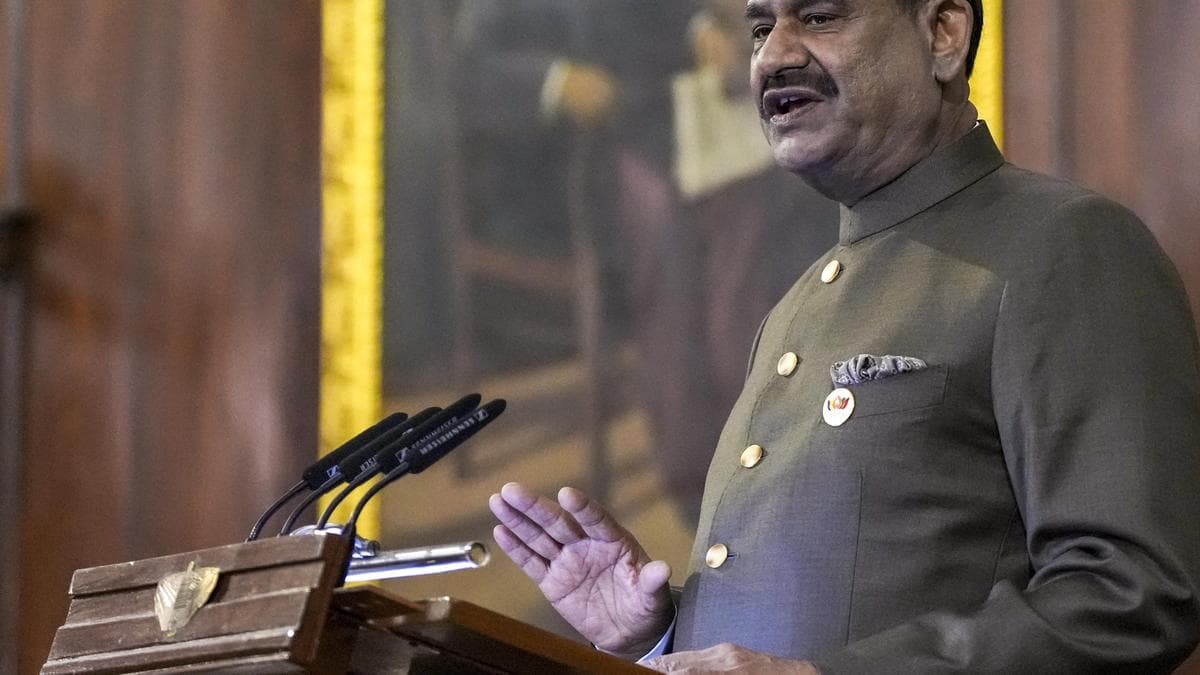
12th BRICS Parliamentary Forum Held in New Delhi Emphasising Multilateral Dialogue and Reform
Oct 26, 2026

IIT Madras Study Examines Unequal Labour Market Impacts of Artificial Intelligence in India
Oct 26, 2026

Houthi Missile Attacks Target Saudi Infrastructure Amid Escalating West Asian Regional Conflict
Oct 26, 2026
Resolving Pricing and Structural Challenges in India's Sugarcane and Sugar Milling Sector
Oct 26, 2026

ICAR-CPRI Develops 'Kufri Jamunia' Biofortified Potato to Tackle Hidden Hunger
Oct 26, 2026