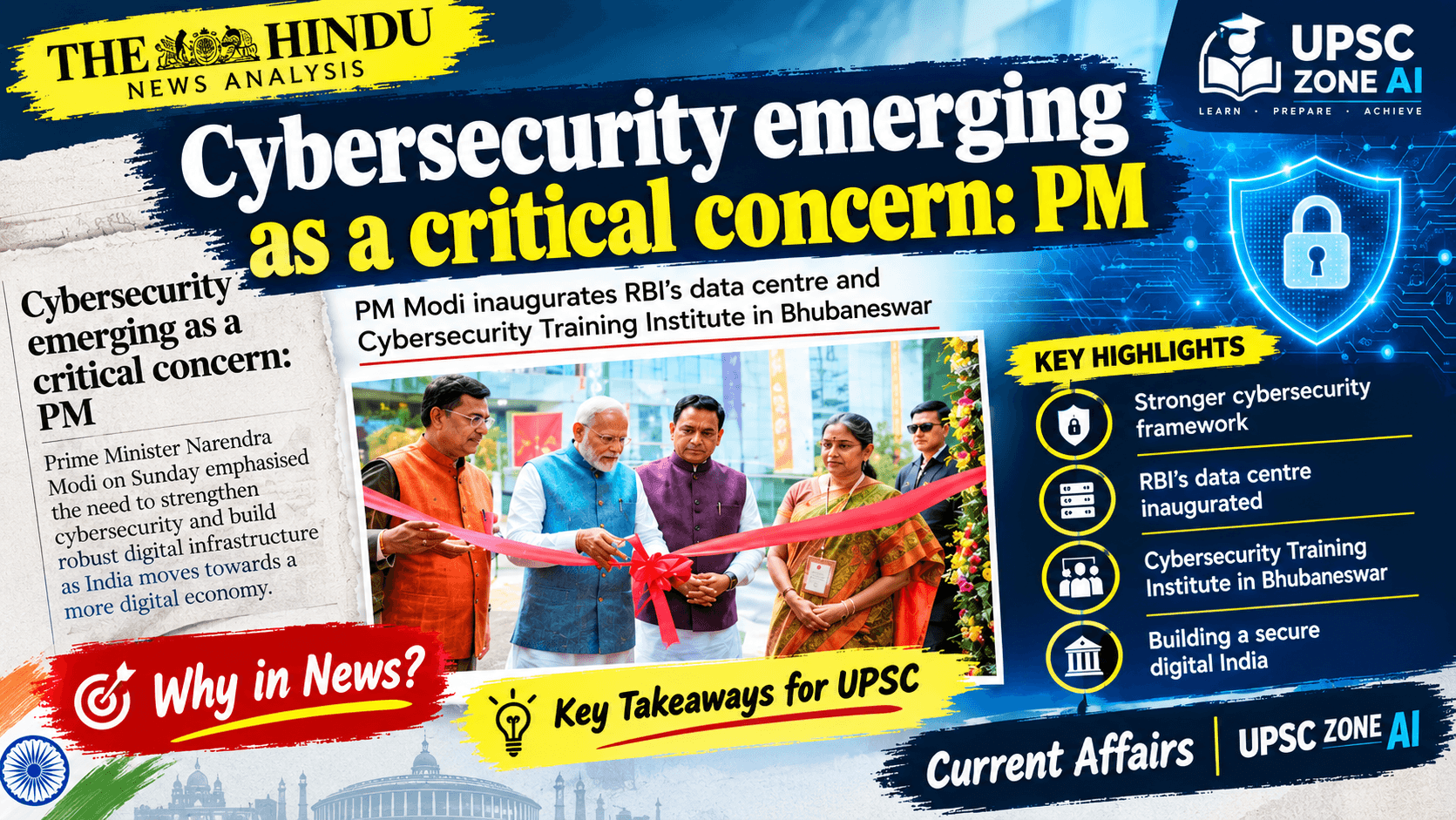
Cybersecurity emerging as a critical concern: Prime Minister
1. General Studies II: Polity and Governance
The inauguration highlights the shift of cybersecurity from a technical domain to a core concern of high-level statecraft and governance.
Live Test Series
Join thousands of aspirants in our weekly live mock tests. Get real-time ranking and detailed analysis.
Role of Key Institutions:
Regulatory State: The event emphasizes the proactive role of the Reserve Bank of India (RBI) as a regulator. It's not just making rules but is physically building the infrastructure to protect the financial sector.
Specialized Agencies: The existence of a specialized Cybersecurity Training Institute under the RBI links directly to the need for a "skilled workforce." This is a key part of India's cyber strategy, complementing agencies like CERT-In (Indian Computer Emergency Response Team), which handles incident response, and NCIIPC (National Critical Information Infrastructure Protection Centre), which protects critical assets.
Protection of Critical Infrastructure: The RBI’s data center is a classic example of Critical Information Infrastructure (CII) as defined under the IT Act, 2000. Its compromise would have a "debilitating impact" on the economy, and the PM's involvement shows a strong executive-level mandate for its protection.
Live NCERT Foundation
Master the basics with our live NCERT classes. The perfect foundation for your UPSC journey.
Cooperative Federalism: The PM's praise for Odisha's growth illustrates the importance of state-level participation in national goals. National cybersecurity resilience is built upon the strength and cooperation of state agencies, police forces, and economic zones.
Political Framing: The political critiques mentioned (about the old "phone banking" system) can be viewed as an example of political positioning in governance. The argument is that moving to a rule-based, digitally secure, inclusive system is a significant governance improvement over a system perceived to be based on personal patronage.
2. General Studies III: Economic Development & Internal Security
This section explores the direct economic impacts and the nature of modern security threats.
Advanced GS Course
Deep dive into General Studies with our comprehensive expert-led modules.
A. Economic Development
Financial Inclusion and Digital India: The article explicitly links the new facility with the success of "Digital India," stating it has taken "banking services to every citizen across the country." This transformation (think UPI, AEPS) has been a driver of massive inclusion but has also created a vast, interconnected landscape of vulnerability.
Protection of Financial Assets: The financial sector is the most lucrative target for cybercriminals. Beyond data theft, a serious attack can disrupt liquidity, undermine confidence in digital payments, and cause a run on banks. This makes the new data center a critical bulwark for economic stability.
Impact on Economic Stability: A major, prolonged cyber-outage would have direct economic costs in terms of lost transactions, productivity, and repair, and even larger indirect costs like reduced investor confidence.
Odisha's Economic Transition: The specific mention of Odisha's move from a minerals-based to a multi-faceted economy highlights that regional economic growth must be protected and integrated into the national security framework.
B. Internal Security
The Changing Nature of Warfare: The PM's statement, "the nature of warfare had made cybersecurity an increasingly critical concern," is key. This describes Hybrid Warfare and Gray Zone Tactics, where cyberattacks (from both state and non-state actors) can be used to disrupt a nation without engaging in traditional, visible, military conflict.
Economic Security as National Security: The quote, "A country can be weakened by attacks on its economy," powerfully underscores that economic and national security are now inseparable. Financial systems are as critical a target as power grids or defense networks.
The Attribution Problem: One of the biggest challenges is that identifying the attacker (state, proxy, or criminal) can be incredibly difficult, making standard deterrence methods ineffective. This puts a premium on robust defense and resilience (e.g., this RBI center).
The Cyber-Physical Link: Cyberattacks are increasingly targeting Operational Technology (OT). An attack on financial systems is an attack on the physical world's ability to trade, pay for services, and conduct business.
3. General Studies IV: Ethics, Integrity, and Aptitude
This pillar addresses the human and societal dimensions.
Value of Public Trust: A banking system functions on trust. A major cybersecurity failure is an ethical failure on the part of the state to fulfill its social contract to protect its citizens' assets.
Equity and Inclusivity (Justice): A robust security system protects everyone, but its failure hits the marginalized the hardest. People who have just entered the formal banking system (e.g., through Jan Dhan accounts) are the least resilient to financial scams and have the least power to recover. Ethically, the state has a heightened duty to protect this group. The critique of the old banking system can be viewed as an ethical critique of exclusive systems.
Accountability: If a major breach occurs, where does the ethical and legal accountability lie? With the RBI? The government? Technical partners? This is a developing ethical challenge in digital governance.
12th BRICS Parliamentary Forum Held in New Delhi Emphasising Multilateral Dialogue and Reform
Oct 26, 2026

IIT Madras Study Examines Unequal Labour Market Impacts of Artificial Intelligence in India
Oct 26, 2026

Houthi Missile Attacks Target Saudi Infrastructure Amid Escalating West Asian Regional Conflict
Oct 26, 2026
Resolving Pricing and Structural Challenges in India's Sugarcane and Sugar Milling Sector
Oct 26, 2026

ICAR-CPRI Develops 'Kufri Jamunia' Biofortified Potato to Tackle Hidden Hunger
Oct 26, 2026