18 held, 100 cr traced in Northeast drug raids: GOVERMENT
The Core Event: A massive, coordinated multi-agency operation across Northeast India has resulted in 18 arrests and the discovery of illegal financial trails (hawala) worth ₹100 crore, stemming from drug trafficking.
Why is this a major internal security concern?
Live Test Series
Join thousands of aspirants in our weekly live mock tests. Get real-time ranking and detailed analysis.
Financing Terrorism and Insurgency (The Drug-Terror Nexus): This is the most critical link. The ₹100 crore traced is not just drug money; it's potentially blood money.
In Northeast India, historically troubled by various ethnic and secessionist insurgencies, drugs are a major source of funds for militant groups.
They use drug money to:
Purchase sophisticated weapons and communication equipment.
Live NCERT Foundation
Master the basics with our live NCERT classes. The perfect foundation for your UPSC journey.
Recruit and pay cadre.
Sustain operational costs and safe havens.
Bribe officials and secure local support.
Crucially: By targeting the money trail (as evidenced by the ₹100 crore trace), security forces are choking the lifeline of these insurgent groups. The Directorate of Enforcement (ED)'s involvement is key here, pointing to intense scrutiny of money laundering.
Advanced GS Course
Deep dive into General Studies with our comprehensive expert-led modules.
Organized Crime and Law & Order:
Trafficking syndicates are well-organized, trans-national criminal organizations. Their operations include armed wings to protect shipments, creating a major law and order challenge.
They corrode the social fabric. The "Corridor of Death" through the Himalayan region indicates a systematic targeting and exploitation of local populations, turning them into addicts and couriers.
The presence of "1,424 bank accounts," "500 detonators," and "cash and assets seized" paints a picture of a massive, sophisticated criminal enterprise, not a simple street-level drug operation.
Social Degradation and Youth Radicalization:
Drug addiction destroys families, communities, and the workforce. A drug-addled population is more vulnerable to radicalization and easier for insurgent groups to manipulate and exploit.
For the state, this means increased healthcare costs and a decline in productive population, hampering regional development.
2. Geopolitics as a Context: GS Paper II (International Relations)
The Golden Triangle: The Root of the Problem
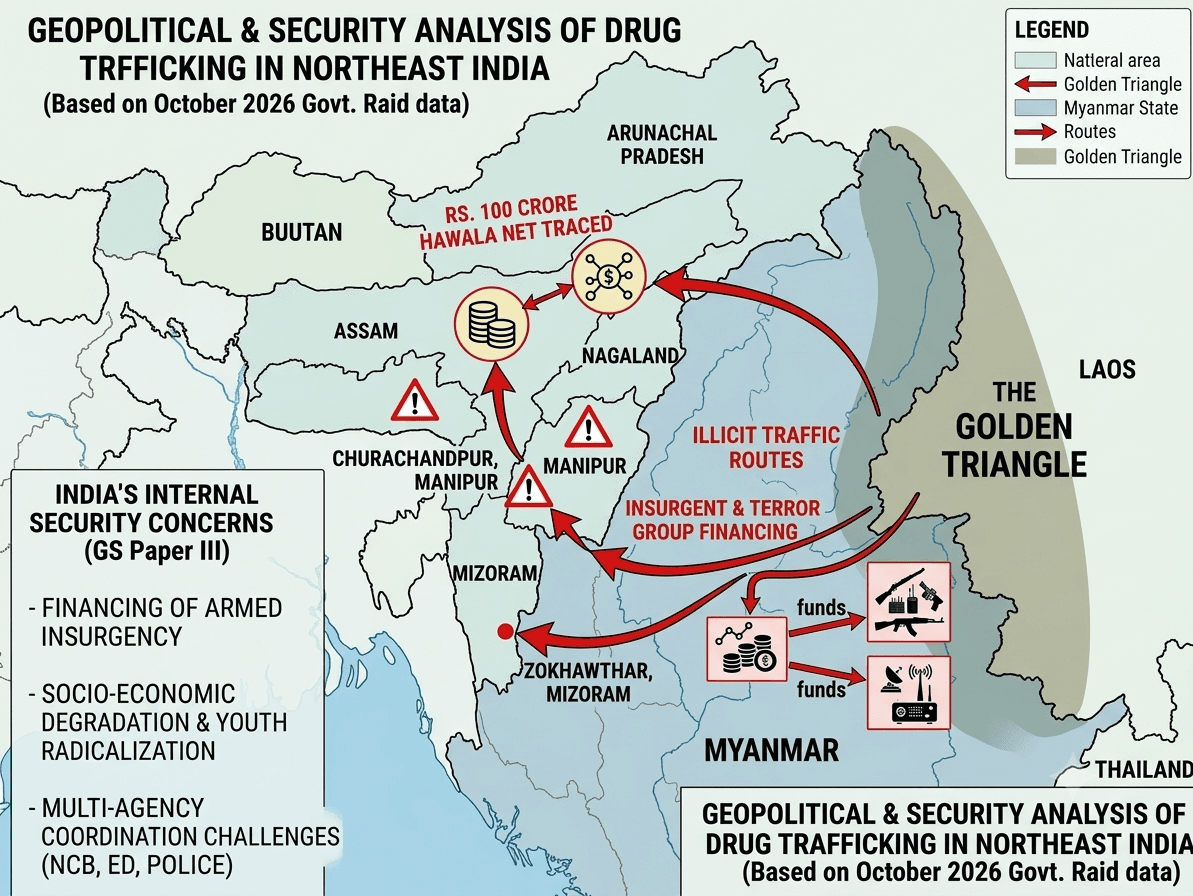
The map I've created visually simplifies this critical concept. Let's analyze it:
What is the Golden Triangle?
It's the tri-junction of Myanmar, Laos, and Thailand. Historically, this region has been one of the world's largest opium-producing and heroin-trafficking hubs.
While poppy cultivation has decreased, the region has now become a global epicenter for the production and trafficking of synthetic drugs, particularly methamphetamines (meth) and yaba.
The political instability, lack of central government control in border areas (especially in Myanmar after the 2021 coup), and porous terrain create a perfect haven for drug cartels.
India's Position: The Proxy Battlefield
India's Northeast is geographically contiguous and highly porous, making it a natural transit corridor for drugs from the Golden Triangle, destined for other parts of India, Bangladesh, and beyond.
States like Mizoram (Champai, Zokhawthar), Manipur (Churachandpur), and Assam (Cachar) are key entry and transit points mentioned in the news report. The geography—dense jungles, hilly terrain, and long, unfenced borders—is a trafficker's paradise.
Myanmar's Strategic Relevance:
The political chaos and conflict in Myanmar, with various ethnic armed organizations (EAOs) and the military junta (Tatmadaw) controlling different regions, have significantly worsened the situation.
Drug production is an easy and critical source of revenue for these warring factions, leading to a surge in production. This increased supply spills over into India.
Therefore, restoring peace and stability in Myanmar is not just an IR priority for India; it's a critical internal security imperative.
3. State Response: The Coordinated Strategy
The news highlights a positive shift: a multi-pronged, multi-agency response.
Coordination is Key: The operation involved a rare synergy between:
Central Agencies: Home Ministry, Narcotics Control Bureau (NCB), and the Enforcement Directorate (ED - crucial for the financial angle).
State Agencies: Manipur, Mizoram, and Assam State Police.
Border Security Force (BSF): They play a critical role on the front lines, and their performance in sealing borders is paramount.
Intelligence-Driven Operations: The report mentions "intelligence collating comprehensive network... through Zokhawthar in Mizoram." This signifies a shift towards pre-emptive, data-driven policing rather than just reactionary operations.
A New Approach: Hitting the Money: The involvement of the ED and the tracing of the ₹100 crore hawala net marks a strategic move to break the economic backbone of drug syndicates. In security parlance, this is "following the money trail."
Policy Target: Mission 2029: Home Minister Amit Shah's statement, "eradication... until the last nail is driven into the coffin," sets a clear, ambitious long-term policy goal. This "Nasha Mukt Bharat Abhiyaan" (Addiction-Free India Campaign) approach shows a sustained commitment.
4. Conclusion: A Multi-Generational Challenge for Aspirants to Address
For a UPSC aspirant, this news isn't just a fact. It's a strategic case study. It demonstrates that:
Security is Seamless: Internal security cannot be divorced from external security/IR. The situation in Myanmar is directly connected to a youth's drug overdose in Guwahati or Delhi.
Coordination is Crucial: No single agency can fight this battle. It requires intelligence sharing, financial tracking, and on-ground policing, all synchronized.
Economic Offenses are Security Threats: Money laundering and hawala are not just economic crimes; they are critical enablers of terrorism and drug trafficking.
The challenge is multi-faceted: it requires strengthening border management, improving regional intelligence, addressing the socioeconomic issues that make populations vulnerable to trafficking, and having a consistent, strategic foreign policy with immediate neighbors like Myanmar. This one news clipping provides material for a comprehensive GS answer, linking geography, polity, economics, and security.
12th BRICS Parliamentary Forum Held in New Delhi Emphasising Multilateral Dialogue and Reform
Oct 26, 2026

IIT Madras Study Examines Unequal Labour Market Impacts of Artificial Intelligence in India
Oct 26, 2026

Houthi Missile Attacks Target Saudi Infrastructure Amid Escalating West Asian Regional Conflict
Oct 26, 2026
Resolving Pricing and Structural Challenges in India's Sugarcane and Sugar Milling Sector
Oct 26, 2026

ICAR-CPRI Develops 'Kufri Jamunia' Biofortified Potato to Tackle Hidden Hunger
Oct 26, 2026