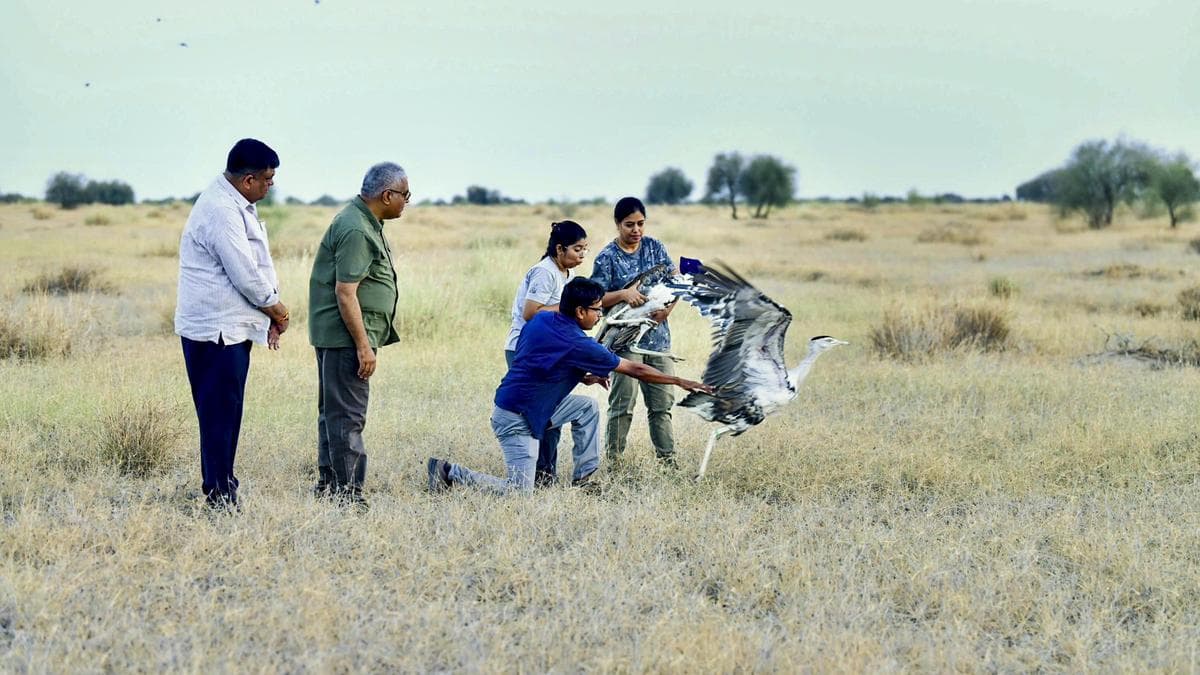
Captive-Bred Great Indian Bustards Released into the Wild at Desert National Park
Union Environment Minister Bhupender Yadav released two captive-bred male Great Indian Bustards into the wild at the Desert National Park in Jaisalmer, Rajasthan. This reintroduction serves as an important initial milestone in the rewilding phase of a long-term ex-situ conservation and recovery effort for the critically endangered bird.
Relevance for UPSC
Wildlife conservation and endangered species management are core topics in General Studies Paper III (Biodiversity and Environment) as well as the Preliminary Examination. Key focus areas include:
Live Test Series
Join thousands of aspirants in our weekly live mock tests. Get real-time ranking and detailed analysis.
- Ex-Situ to In-Situ Linkages: The application of scientific captive-breeding programs to augment dwindling wild populations of flagship grassland species.
- Institutional Collaboration: Multi-agency coordination between the Union Ministry of Environment, Forest and Climate Change, state forest departments, and apex research bodies like the Wildlife Institute of India (WII).
- Protected Area Ecology: The role of Desert National Park in sustaining viable habitats for arid-zone avifauna facing existential threats.
Conservation Background and Program Scale
The reintroduction represents nearly a decade of collaborative research and field efforts undertaken jointly by the Union Environment Ministry, the Rajasthan Forest Department, and the Wildlife Institute of India. The two released males were reared at specialized breeding facilities located in Sam and Ramdevra within Jaisalmer district.
According to official records, these dedicated facilities accommodate a total of 97 birds. Of this population, 40 originated from eggs gathered from the wild, while 57 were successfully bred in captivity. Program managers have reserved 86 birds to sustain ongoing captive reproduction efforts, while 11 individuals have been selected for eventual wild reintroduction. The captive-breeding methodology has yielded steady demographic gains, producing 24 live chicks in 2025 and 29 in 2026.
Reported by The Hindu — National

Reservation Policy, Religious Conversion and Social Backwardness in India with Question
Oct 16, 2026

Debate Over Jammu and Kashmir Reservation Policy and the Fifty Percent Quota Cap
Oct 16, 2026
Uttar Pradesh Initiates Housing Projects for the Urban Poor on Reclaimed Land in Prayagraj
Oct 16, 2026

DGMA Restricts Indian Seafarer Deployment in Sarawak and Mandates Insurance Safeguards
Oct 16, 2026
Administrative Protocol and Order of Precedence for Members of Parliament at Public Functions
Oct 16, 2026