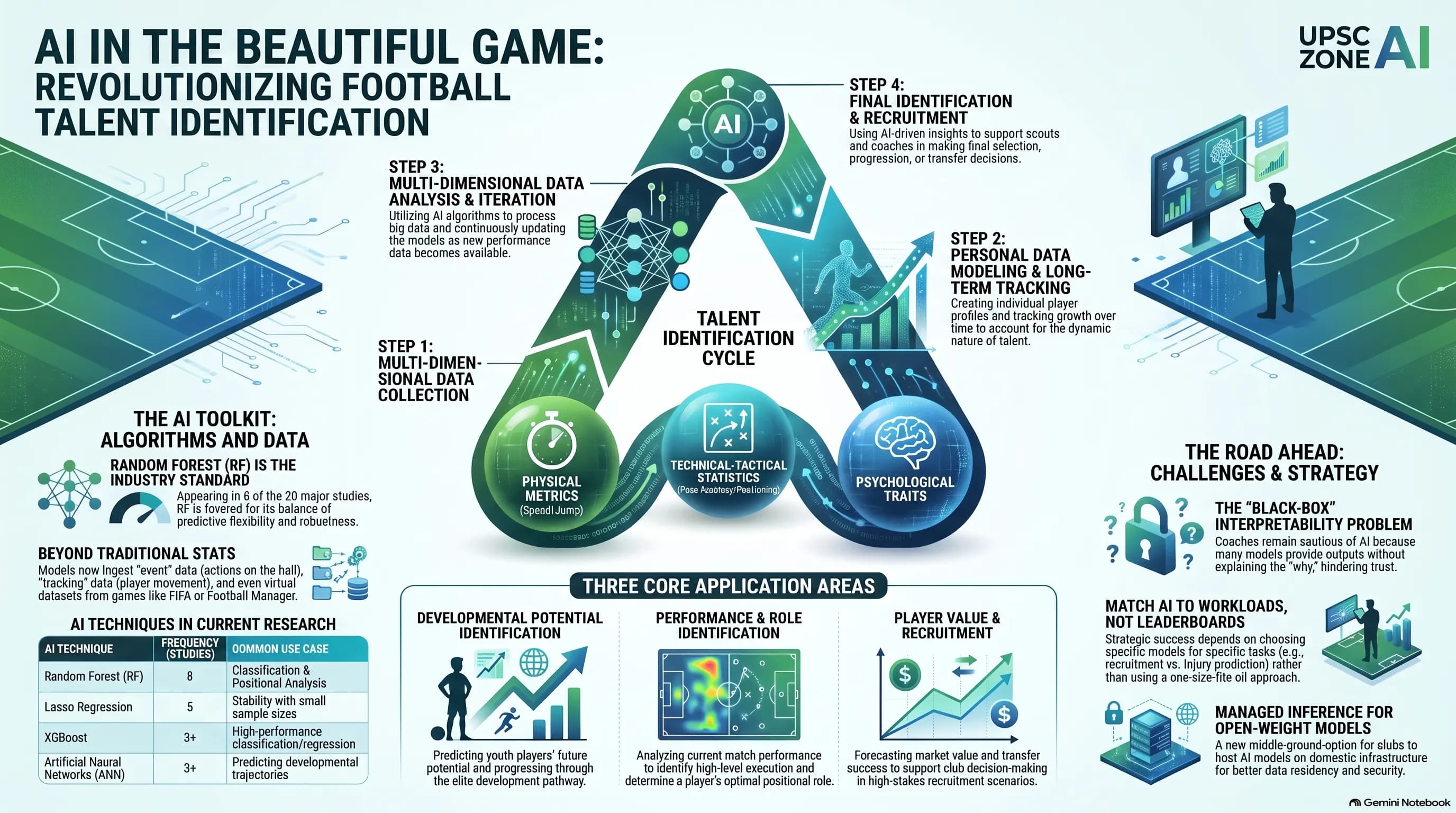
What specific biases (like biological maturation) do AI models encounter?
AI models in football talent identification encounter several distinct structural and systemic biases. Because machine learning algorithms rely heavily on the quality and representativeness of their training data, they risk codifying and magnifying existing human prejudices rather than correcting them.
The primary biases identified in the systematic review include:
Live Test Series
Join thousands of aspirants in our weekly live mock tests. Get real-time ranking and detailed analysis.
1. Biological Maturation and Relative Age Bias
The Issue: Adolescent physical development is highly non-linear and varies wildly from player to player. Historically, human scouts have exhibited a strong bias toward selecting early-maturing players who are physically larger, faster, and stronger in the short term.
The AI Impact: When AI models are trained on historical academy selection datasets, they ingest data that already reflects this historical bias. Consequently, the algorithms learn to associate early physical maturation and relative age advantages with high potential, unintentionally reinforcing and perpetuating the over-selection of early-maturing players.
2. Gender Bias
The Issue: There is a severe structural imbalance in women's football regarding research attention, funding, data availability, and developmental resources. Furthermore, evaluating female players involves highly specific, complex physiological factors (such as the impact of the menstrual cycle on training and match performance) and different career risks (such as a significantly higher burden of ACL injuries).
The AI Impact: Because the vast majority of AI models and evaluation frameworks are designed and trained exclusively on male cohorts, they cannot be directly applied to women. Attempting to do so results in highly inaccurate, biased evaluations of female players' potential and actively reinforces existing gender inequalities in sports science.
Live NCERT Foundation
Master the basics with our live NCERT classes. The perfect foundation for your UPSC journey.
3. Geographical and Cultural Bias
The Issue: The current body of research on AI talent identification is heavily concentrated within European football contexts. This geographical imbalance is driven by the widespread availability of highly structured tracking and event datasets commercialised by major European leagues and data providers.
The AI Impact: Because the training data is highly specific to European playing styles, infrastructure, and competition standards, the resulting AI models have very limited generalisability and applicability to non-European football environments.
4. Selection and "System Fit" Bias
The Issue: Most youth academy datasets are highly selective, representing small cohorts of players who have already entered elite pathways. Additionally, researchers typically rely on cross-sectional data (a snapshot of performance at a single point in time) rather than longitudinal tracking across multiple seasons.
The AI Impact: AI models trained on these narrow datasets are heavily biased toward predicting "players who currently fit the existing system". Because youth development is non-linear and occurs in discontinuous bursts, these models struggle to identify late-developing "outliers" who might actually possess the highest long-term professional ceiling.
Advanced GS Course
Deep dive into General Studies with our comprehensive expert-led modules.
⚖️ Would you like me to draft a set of study notes comparing how researchers propose to mitigate these data biases (such as using anomaly detection or multimodal data integration) to make AI models fairer in youth academies?
AI in Talent Identification: Capabilities vs. Constraints
Aug 20, 2026
Critical Evaluation: The "So What?" Layer of Technological Adoption
Aug 20, 2026
How does AI predict a youth player's professional development potential?
Aug 20, 2026

What is g-AMIE?
Aug 18, 2026

Can Chatbots Serve Doctors and Patients?
Aug 18, 2026