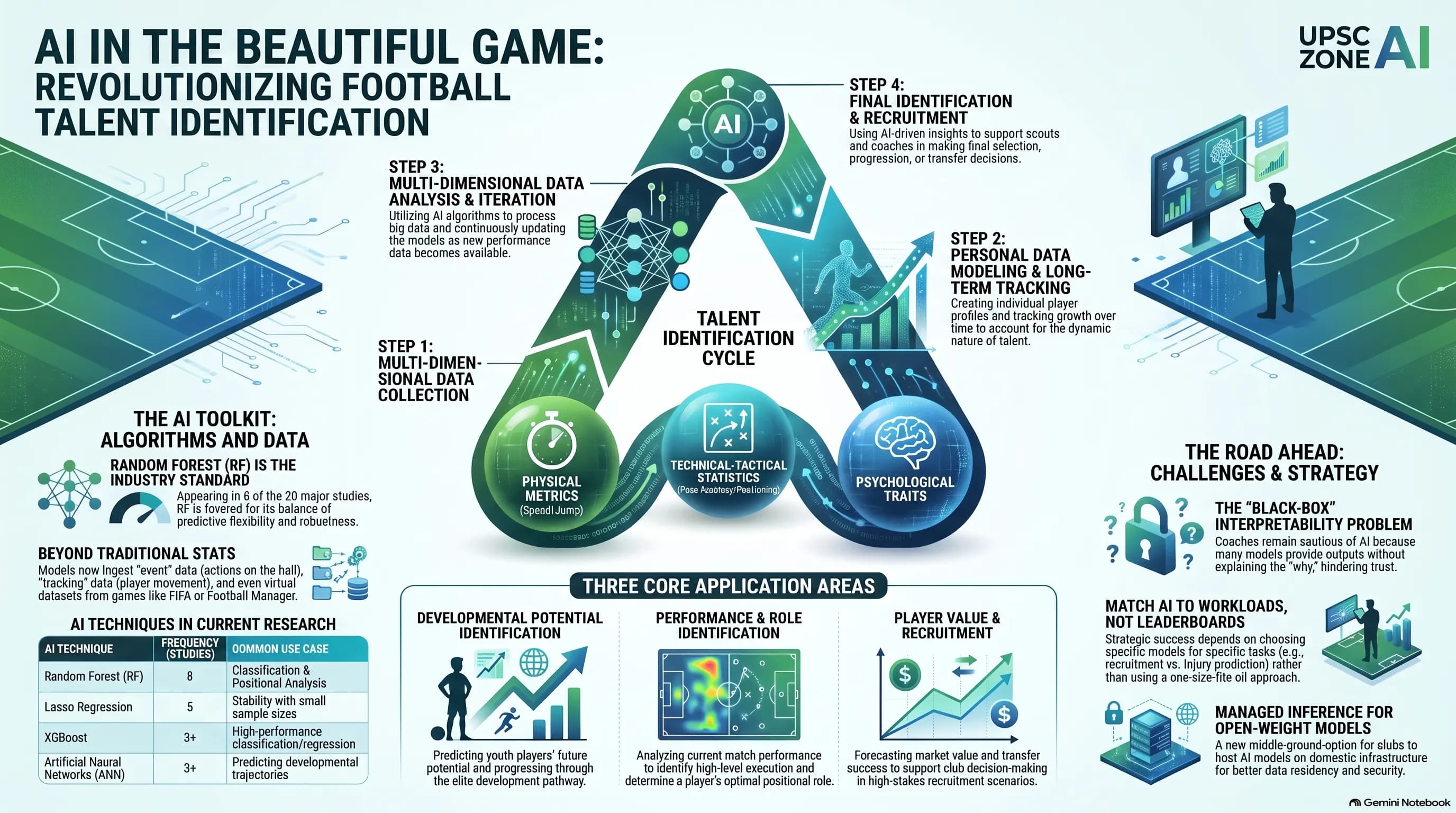
How does AI predict a youth player's professional development potential?
Artificial intelligence (AI) predicts a youth football player’s professional development potential by transitioning talent identification from subjective, experience-based scouting to data-driven, objective decision-making. This predictive process relies on specific machine learning techniques, multidimensional input features, and distinct evaluation frameworks, though it also faces several critical real-world limitations.
1. Key AI Techniques Used
In youth talent identification, traditional machine learning models are the most frequently applied:
Live Test Series
Join thousands of aspirants in our weekly live mock tests. Get real-time ranking and detailed analysis.
Random Forest, XGBoost, and Regression Models: These are the most common techniques used for structured youth datasets because they provide a practical balance between predictive flexibility, interpretability, computational feasibility, and robustness.
One-Class Support Vector Machines (SVM): These are employed as anomaly-detection frameworks to identify "elite-potential" outliers from a large pool of typically developing youth players.
Deep Learning Models: Deep neural networks (DNNs) are used to predict longer-term player potential and trajectories by capturing non-linear relationships across massive data points.
2. Multidimensional Input Features
Rather than relying on isolated metrics, AI models evaluate a player's development potential using a multidisciplinary mix of indicators:
Live NCERT Foundation
Master the basics with our live NCERT classes. The perfect foundation for your UPSC journey.
Physical and Fitness Attributes: Standard athletic indicators such as speed, jump performance, height, weight, and endurance.
Technical-Tactical Indicators: Match performance statistics, passing accuracy, event data, and ball-tracking metrics.
Maturity-Related and Physiological Measures: Biological maturation levels, perceived competence, and age-category metrics.
Psychological and Social Factors: Psychological perceptions, self-assessment questionnaires, and qualitative ratings provided by coaches.
Advanced GS Course
Deep dive into General Studies with our comprehensive expert-led modules.
Career History: Prior match experience, league level, and injury history.
3. Predictive Goals and Outputs
The primary objective of these models in youth academies is classification and scoring. Typically, the AI outputs a prediction of whether a player will successfully progress to higher age categories (e.g., moving up through U12 to U19) or transition into adult professional status.
Key Challenges & Limitations
While AI shows promising potential in youth development forecasting, the systematic review highlights several structural bottlenecks that prevent it from replacing traditional methods:
Biological Maturation and Maturation Bias: Adolescents develop at highly varied rates. Traditional scouting often over-selects early-maturing players. If AI is trained on historical data that already reflects this "relative age" bias, the models will unintentionally reinforce and perpetuate the selection of early-maturing players rather than correcting it.
Cross-Sectional vs. Non-linear Growth: Youth talent development is non-linear; physical, technical, and psychological growth occurs in unpredictable, stage-like patterns. However, most AI models rely on cross-sectional data collected at a single point in time, which cannot capture these discontinuous trajectories. Consequently, models tend to identify "players who currently fit the system" rather than those with the highest long-term ceiling.
The "Black-Box" Problem: Highly complex AI models lack transparency. If a model predicts a player's failure or success without explaining the underlying rationale, coaches and scouts cannot easily verify the result, leading to a lack of trust in practical academy environments.
🔍 Would you like me to create an outline or notes focusing on the specific biases (such as biological maturation and gender) that AI models encounter in sports science?
AI in Talent Identification: Capabilities vs. Constraints
Aug 20, 2026
Critical Evaluation: The "So What?" Layer of Technological Adoption
Aug 20, 2026
What specific biases (like biological maturation) do AI models encounter?
Aug 20, 2026
What is g-AMIE?
Aug 18, 2026

Can Chatbots Serve Doctors and Patients?
Aug 18, 2026