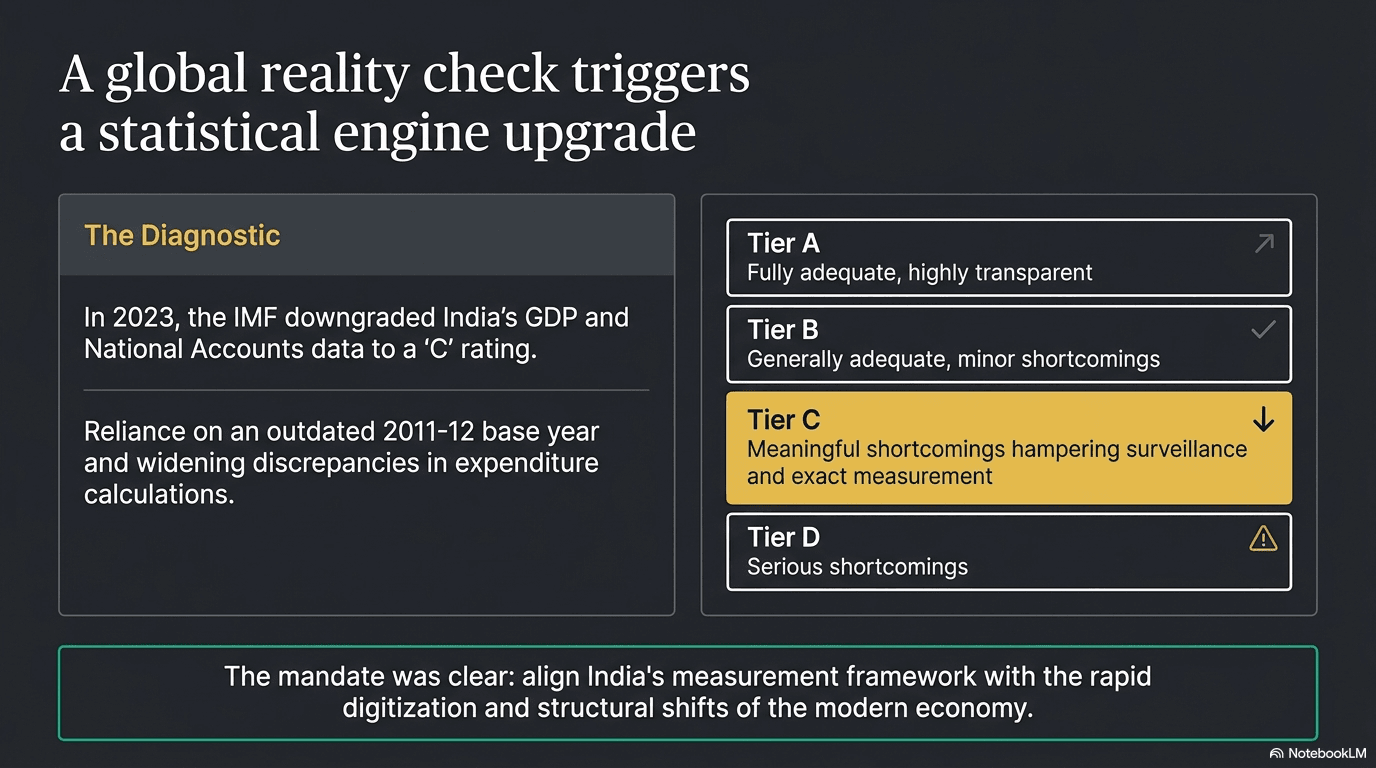
What is the meaning of IMF Rating C?
An IMF Rating C indicates that a country’s national accounts and inflation data have shortcomings that somewhat hamper surveillance. According to the sources, the International Monetary Fund (IMF) issues four types of ratings (A, B, C, and D) to evaluate the quality of a country's data calculation.
Specifically, a "C" rating signifies the following:
Live Test Series
Join thousands of aspirants in our weekly live mock tests. Get real-time ranking and detailed analysis.
Increased Shortcomings: While a Grade B rating is for data with only minor issues, a Grade C is assigned when shortcomings increase, suggesting the data does not adequately capture the economic situation.
Data Discrepancies: It implies there are issues with data collection, calculation, or analysis, leading to discrepancies.
Surveillance Impact: These issues are significant enough that they hinder the IMF's ability to monitor and assess the economy effectively.
In the context of India, the IMF downgraded the rating to "C" because the national accounts were based on an outdated base year (2011-12) and showed discrepancies between the production and expenditure methods of calculating GDP. This rating served as a primary reason for the Indian government to initiate the current base year revision and methodological updates to align with global standards.
Live NCERT Foundation
Master the basics with our live NCERT classes. The perfect foundation for your UPSC journey.
What is the meaning of IMF Rating C?
Aug 1, 2026

How do double deflation and supply use tables improve data?
Aug 1, 2026

Does EWS reservation include people from SC and ST groups?
Jul 29, 2026

Why is the 103rd Amendment's constitutional validity being challenged?
Jul 29, 2026

What is the historical purpose of India's reservation system?
Jul 29, 2026