What is the controversy regarding Indian seafarers and US strikes?
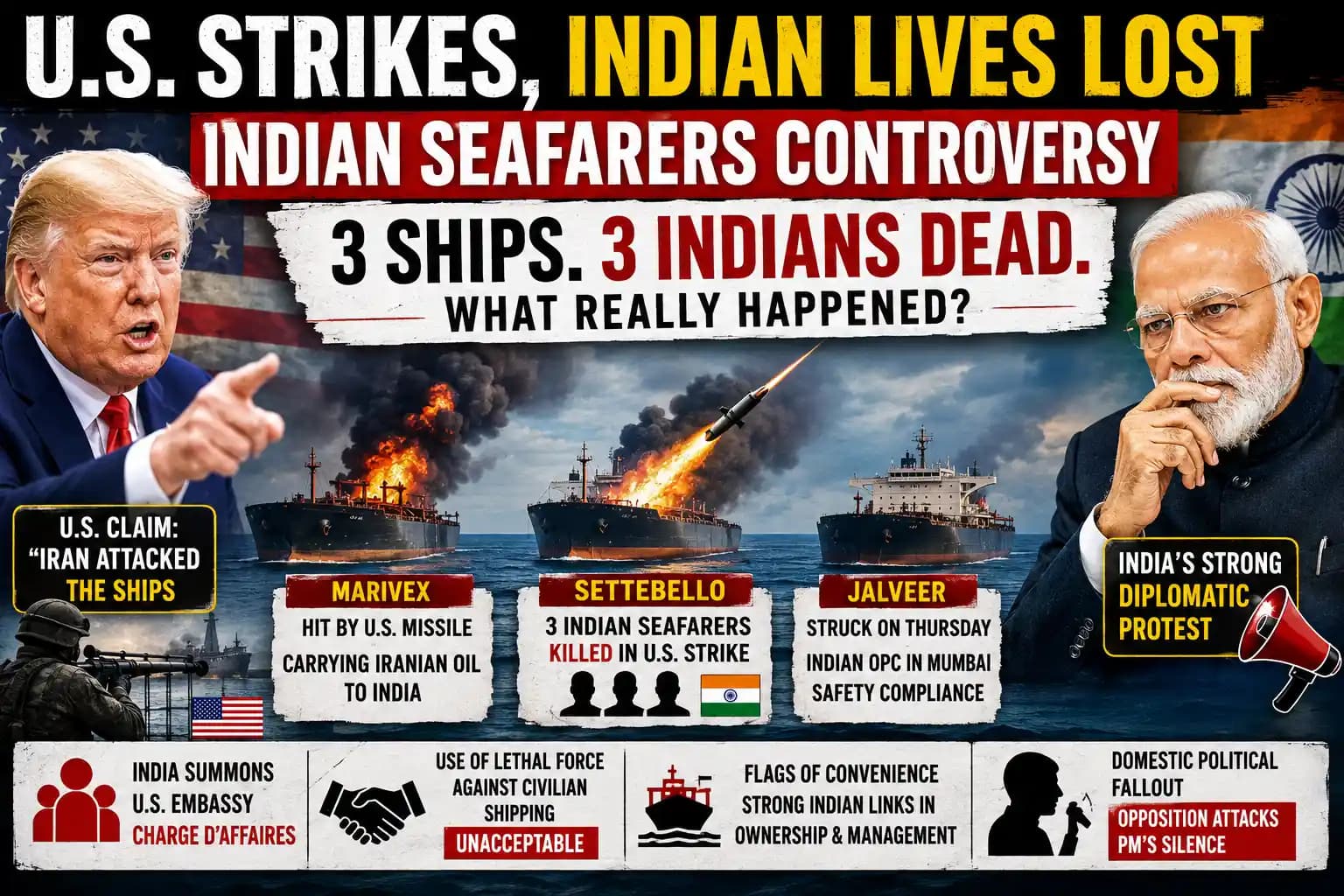
The controversy regarding Indian seafarers and U.S. strikes stems from U.S. military attacks on three ships in international waters that resulted in the deaths of three Indian seafarers. While the ships were foreign-flagged, they had strong Indian links in ownership and management, and were serving Indian ports to facilitate oil trade.
Key elements of the controversy include:
Live Test Series
Join thousands of aspirants in our weekly live mock tests. Get real-time ranking and detailed analysis.
1. Diplomatic Protest from India
The Indian Ministry of External Affairs initially described the deaths as "incidental collateral damage" to avoid the notion that Indians were being targeted. However, the Ministry later summoned the U.S. Embassy Charge d’Affaires, Jason Meeks, to lodge a "strong protest". India expressed deep concern over the "use of lethal and deadly force against civilian shipping," calling such actions "unacceptable" and a threat to the stability of international maritime commerce.
2. Conflicting Narratives and Target Identification
The U.S. Position: President Donald Trump accused Iran of carrying out "totally unacceptable" drone attacks on the Indian ships as they were leaving the Strait of Hormuz. U.S. Central Command claimed the ships' crews "repeatedly failed to comply with directions from American sources".
The Iranian Position: A spokesperson for Iran’s Foreign Affairs Ministry condemned the U.S. actions, explicitly describing them as "attacks on Indian commercial vessels".
Shipping Managers' Rebuttal: The manager of the Settebello—the ship where the three Indians died—disputed the U.S. version, stating no contact or warning was received from the U.S. Navy before the strike.
Live NCERT Foundation
Master the basics with our live NCERT classes. The perfect foundation for your UPSC journey.
3. "Flags of Convenience" and Indian Links
The three ships involved were registered in countries known as "flags of convenience" (such as Panama and Guinea Bissau) to minimize oversight while catering to India's oil needs from sanctioned countries like Russia and Iran.
Marivex: Hit by a U.S. missile while carrying Iranian oil bound for Mangalore; it is owned by a Panama-registered company with several Indian associates.
Settebello: The vessel where the three Indian seafarers were killed; it had been managed by Indian ship management companies in the past and was on a U.S. non-profit's list for trading in Iranian oil.
Jalveer: Struck on a Thursday, this ship has a "One Person Company" in Mumbai listed as responsible for its safety compliance.
Advanced GS Course
Deep dive into General Studies with our comprehensive expert-led modules.
4. Domestic Political Fallout
The incident has triggered political criticism within India. Leader of the Opposition Rahul Gandhi attacked Prime Minister Narendra Modi for his silence on the matter. Gandhi alleged that a "compromised PM" was failing to protect "the sons of Mother India" and questioned why the Prime Minister had not confronted the foreign power responsible for the deaths. The Congress party further condemned the "reckless military actions" and demanded diplomatic measures to ensure accountability.

Explain the legal issues surrounding neutral ships in combat zones.
Jun 29, 2026
How do AI and 'collaborative caching' assist in disaster response?
Jun 29, 2026
What are the new FCRA rules for NGOs in India?
Jun 24, 2026

How is India modernising its regulatory framework and business climate?
Jun 22, 2026

How will the Middle East conflict impact global energy prices?
Jun 20, 2026