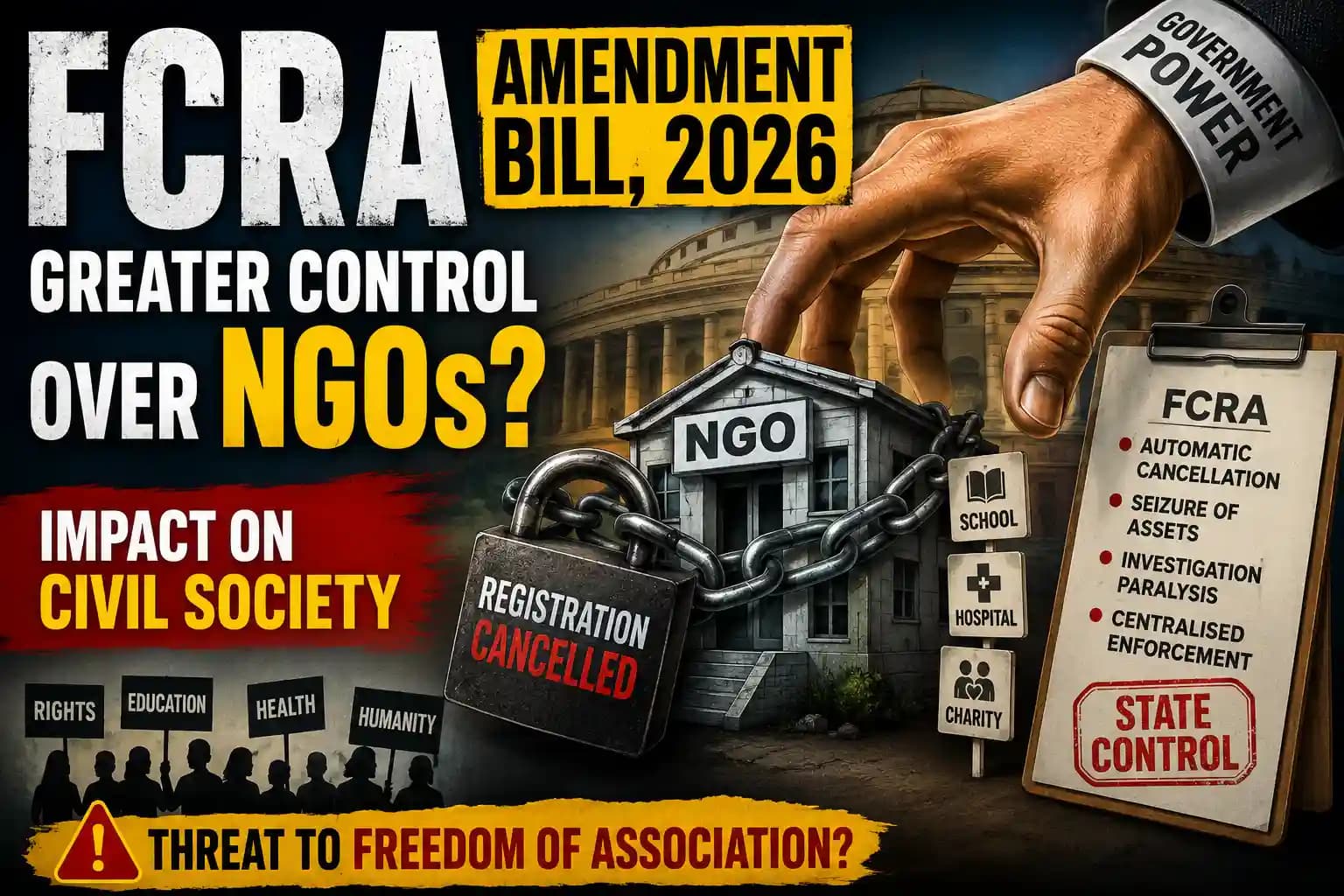
What impact does the FCRA Bill have on Indian civil society?
The Foreign Contribution (Regulation) Amendment (FCRA) Bill, 2026, significantly increases executive power, moving beyond mere regulation to enable extensive state control over non-governmental organisations (NGOs), charitable trusts, and educational and religious institutions.
According to the sources, the impact of this Bill on Indian civil society includes:
Live Test Series
Join thousands of aspirants in our weekly live mock tests. Get real-time ranking and detailed analysis.
Legal and Administrative Overreach
Automatic Cessation of Registration: Under the proposed Section 14B, an organisation’s registration can automatically "cease" if it fails to apply for renewal on time or if its renewal remains pending. This allows institutions to be paralysed through procedural delays rather than proven misconduct.
Seizure of Assets: The most critical provision, Section 16A, allows all foreign contributions and derived assets to automatically "provisionally vest" in a government-designated authority upon the cancellation or cessation of registration, without prior judicial review. If restoration is not secured, this vesting becomes permanent, enabling the state to manage, transfer, or sell properties—such as schools, hospitals, and places of worship—with proceeds going to the Consolidated Fund of India.
Paralysis During Investigation: Amended Section 13 prevents organisations from managing their assets without prior approval during suspension, effectively shutting down their operations during investigations.
Centralised Enforcement: Section 43 centralises enforcement by requiring Union government approval before any state agency can investigate violations.
Live NCERT Foundation
Master the basics with our live NCERT classes. The perfect foundation for your UPSC journey.
Economic and Social Impact
Disruption of Welfare Services: The sector contributes roughly 2% of India's GDP. Revoking licences threatens ongoing efforts in child protection, immunisation, neonatal health, nutrition, and early childhood education.
Job and Volunteer Loss: Civil society generates 27 lakh jobs and 34 lakh full-time volunteers, surpassing public sector employment. Revocations risk leaving roughly four lakh to eight lakh individuals per organisation without access to vital services.
Threat to Minority Institutions: The Bill is seen as a major threat to minority communities, particularly Christian organisations that run thousands of schools, colleges, and hospitals. There are concerns that the government is systematically targeting these institutions for property takeover under the guise of procedural non-compliance.
Constitutional and Human Rights Concerns
Chilling Effect: Increased personal liability for office-bearers and broader definitions of "key functionaries" risk creating a climate of fear that discourages participation in civil society.
Advanced GS Course
Deep dive into General Studies with our comprehensive expert-led modules.
Constitutional Violations: Critics argue the Bill undermines several constitutional rights, including freedom of association (Article 19(1)(c)), the autonomy of religious and educational institutions (Articles 25, 26, 29, 30), and property rights (Article 300A).
Vague Standards: The use of broad, subjective grounds like "public interest" for licence cancellation gives the executive wide discretion to target organisations involved in public advocacy, human rights, or environmental protection.

Explain the legal issues surrounding neutral ships in combat zones.
Jun 29, 2026
How do AI and 'collaborative caching' assist in disaster response?
Jun 29, 2026
What are the new FCRA rules for NGOs in India?
Jun 24, 2026
How is India modernising its regulatory framework and business climate?
Jun 22, 2026

How will the Middle East conflict impact global energy prices?
Jun 20, 2026